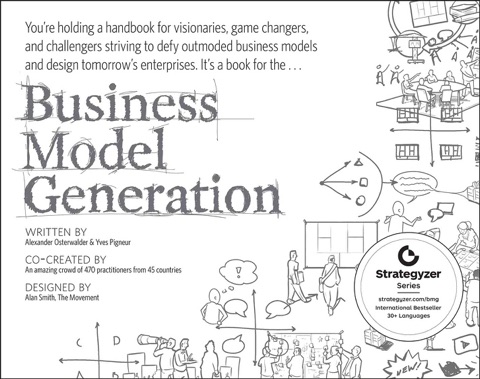
Business Model Generation by Osterwalder and Pigneur: a camera, not a compass
 Quentin Dupard
Nine boxes on one page, and the claim that any business can be described by filling them in. The claim holds. What the book oversells is what happens next: a canvas shows you the model you have, with great clarity, and says nothing about whether it is true. It is a camera, not a compass — and a camera is worth owning.
I use the canvas in most engagements and I have never once used it the way the book intends.
The canvas, in one paragraph
A business model, in the book’s definition, is the rationale for how an organisation creates, delivers and captures value. The canvas spreads that across nine blocks: who you serve (Customer Segments), what you promise them (Value Propositions), how it reaches them (Channels), how you keep them (Customer Relationships), what they pay (Revenue Streams), what you must own (Key Resources), do (Key Activities) and buy in (Key Partnerships), and what it all costs (Cost Structure). Customers and money on the right, machinery and cost on the left, the promise in the middle. One page, sticky notes, no appendix.
The rest of the book is five sections wrapped around that grid: a patterns catalogue, a set of design techniques borrowed from product design, a strategy chapter, and a five-phase process — Mobilize, Understand, Design, Implement, Manage — for running the whole thing inside a company.
What it is actually for
The book says the canvas is a tool for inventing new business models. In ten years of using it I have watched it do something humbler and more valuable: it ends the meeting where everyone in the room is describing a different company.
Ask a founder, their head of sales and their head of product to fill in the nine boxes separately and you will get three different businesses. The pricing argument you were hired for usually turns out to be a disagreement about which customer segment the company actually serves, and nobody knew, because the disagreement had nowhere to become visible. One page makes it visible in twenty minutes. That is not innovation. It is something rarer — a shared sentence everyone has agreed to argue about.
The authors half-know this. Buried in the making-of chapter, one of the 470 contributors calls a business model the “core content” or the “short story” of the company, and the business plan merely the full text. That one line is a better description of the canvas than the subtitle is.
The three things I use
The five tests for splitting a segment. The book says customer groups are separate segments only if they need a distinct offer, reach you through different channels, need different relationships, have substantially different profitability, or pay for different aspects of the offer. That list is a scalpel. Most of the personas I am shown fail all five tests — they are demographics wearing a name badge. Segmentation is an economics decision, not a creative-team deliverable, and this is the cleanest statement of it I know.
Which side do you subsidise, on purpose. The platforms chapter is built on the chicken-and-egg problem: a platform is worthless to each side without the other, so you lure one side with a cheap or free offer and charge the other. The book’s contrast is exact. Sony subsidised every PlayStation 3 sold, betting on game royalties that came in under estimate. Nintendo aimed the Wii at casual players with cheaper technology and made money on the console and the royalties — same pattern, opposite subsidy, opposite result. The lesson generalises well beyond consoles: if part of your business is free, you should be able to say which paying side it feeds and how. If you cannot, it is not a subsidy. It is just a cost.
The kill/thrill session. One page of the process chapter, worth the price of the book: put the new idea in front of the team, spend twenty minutes brainstorming only reasons it will fail, then twenty minutes only reasons it will fly. Splitting the two moods stops the optimists and the sceptics from cancelling each other into mush. I run it on roadmaps and pricing changes, not business models, and it works everywhere.
Findings for product
- Draw the model you have before the one you want. Not the aspiration — the current machine, as it actually runs. Most teams discover the two differ in at least three boxes, and the gap is the roadmap conversation they have been avoiding.
- Run your personas through the five segment tests. Distinct offer, distinct channel, distinct relationship, distinct profitability, distinct willingness to pay. A persona that fails all five is not a segment and should not have its own roadmap line, its own pricing tier, or its own onboarding flow.
- Mark every box as fact or guess. This is my repair for the canvas’s biggest flaw: a grid full of validated knowledge looks identical to a grid full of wishes. Two colours of sticky note — tested, untested. The untested notes in Revenue Streams and Channels are your riskiest assumptions, and now they are visible.
- A free tier is a subsidy with a job. Name the paying side it feeds and the mechanism — the Metro newspaper carried free readers because advertisers paid for their attention. If your free users do not structurally feed a paying side, you have not designed a freemium model. You have designed a cost.
- Assume the model has a shelf life. The Manage chapter’s bleakest and most useful sentence: it is best to assume that most business models, even successful ones, will have a short lifespan. The book’s own warning case is Dell — a model so successful the company could not rethink it, stuck in a commoditised market while the growth moved elsewhere. Somebody in the building should own the question of what replaces the machine while it still works.
Product test: could your team fill in the nine boxes separately and produce the same company? If not, that argument is your next planning meeting.
Findings for marketing
- Segments before channels, always. The canvas is ordered: who, then what, then how it reaches them. Most marketing plans I read are ordered backwards — they start with the channel list and back into an audience. If you cannot fill the Segments and Value Proposition boxes first, the channel plan is a budget allocation, not a strategy.
- Audit your copy against the value-creation list. The book names the ways a proposition creates value: newness, performance, customisation, getting the job done, design, brand, price, cost reduction, risk reduction, accessibility, convenience. Read your homepage and mark which one it claims. Most B2B sites claim performance out of habit while their customers actually buy risk reduction — and the copy never says the word.
- Name your pattern and you find your real competitor. The book’s patterns — unbundling, long tail, multi-sided platform, free, open — are competitive lenses. Lulu did not beat publishers with better marketing; it made selection irrelevant by profiting from books publishers rejected, because print-on-demand means a title that never sells costs nothing. If your rival runs a different pattern, you are not competing on features, and feature comparisons are wasted copy.
- Position against the model, not the product. The Wii shipped weaker technology on purpose and sold it as a feature to people the incumbents ignored. When you are outgunned on performance, the answer the book keeps illustrating is to change who you are for and what they pay for — not to close the spec gap.
- The canvas is the deck. Segment, promise, proof, price — the right-hand side of the canvas read left to right is the narrative order of a sales deck, and of a homepage. If a section of your pitch does not map to a box, it is decoration.
Marketing test: which one of the eleven value types does your homepage claim, in its actual words? If you find three, the reader found none.
What this means for what to build and what to kill
The canvas’s most commercial use is the one the book never names: it generates a kill list. Draw the model you actually run, then walk the roadmap against it — anything in the product that feeds no segment’s value proposition and no revenue stream has no box to live in, and a feature without a box is a cost wearing a feature’s clothes. Most roadmaps I audit carry three or four of these, defended by the person who built them and by nobody else. Deciding what to build is a workshop; deciding what to kill is the part people bring me in for, because it needs someone with no sunk feelings in the room.
Run the same sweep on the pricing grid. The five segment tests are a tier audit: a plan that serves no distinct segment — same offer, same channel, same willingness to pay as its neighbour — is packaging debt, and merging it is the fastest pricing work there is, because nothing new has to be built. Most three-tier pages are two real segments and one tier that exists for the contrast.
One caution before the knife comes out: usage data alone will lie to you about what is killable. A feature nobody opens can still be holding a customer’s stored value — their archive, their configuration, the thing they would have to rebuild elsewhere — and killing it cuts the switching cost you spent years building. Hooked’s investment chapter is the checklist for what looks idle but is actually load-bearing.
And the Dell warning is a calendar entry, not a moral. A model so successful nobody may question it is the book’s definition of the next casualty, so somebody should own the question of what replaces the machine while it still runs — quarterly, with the canvas on the wall. In a company too small for a strategy team, that is precisely what a fractional operator is for.
Where it does not hold up
A description tool sold as an invention tool. The subtitle promises game changers. The grid cannot tell a validated model from a wished-for one — nine boxes of confident guesses photograph beautifully. The book itself never claims the canvas tests anything, but it lets you forget that for two hundred pages, and the workshops it spawned forgot it permanently. Every canvas needs a second question the page does not ask: how do you know?
The model is a loop; the canvas is a snapshot. Google’s model works because more users make the ads worth more, which funds better free tools, which bring more users. That loop is the business. The grid has no way to say it — which is why the book’s own Google pages are covered in hand-drawn arrows fighting the format. A model is a machine running in time, and the canvas is a photograph of the machine switched off.
Competition lives off the page. Rivals, substitutes, regulation and market shifts are relegated to an “environment” chapter near the back, with SWOT and a bolted-on tour of Blue Ocean Strategy. On the page where decisions get made, your model floats alone in space. The Wii story is the book’s best material precisely because it is one of the few places two canvases are made to fight.
Pricing gets one box. Revenue Streams asks the right question — for what value is each segment actually willing to pay? — and answers it with a list of mechanisms: asset sale, subscription, licensing, auction. The question that determines whether the whole page makes money is dispatched at sticky-note depth. My entire trade lives inside that one box, which perhaps explains my affection for the other eight.
Co-created by 470 people, and it shows both ways. The crowd is the book’s evidence and its bias. It was financed and produced outside traditional publishing, by practitioners, most of them consultants and facilitators — and the result is optimised for the room it was written in. The canvas is genuinely the best workshop artefact ever shipped in business print. It is better at producing agreement than at producing revenue, and agreement is what workshops sell.
The examples are a 2010 time capsule. Skype as the disruptor, Nokia’s “comes with music” as an adaptive move, LEGO Factory — which the book itself admits produced only a small fraction of revenue — as the long-tail future. Some aged into warnings. That is not disqualifying; the Dell caution aged into a prophecy. But read the cases as illustrations of patterns, not as bets that paid.
Who should read it
Read it if you run, advise or own a company where the leadership would describe the business differently in private — which is most companies. Read the segments chapter, the platforms pattern and the kill/thrill page even if you skip everything else. And put the canvas on the wall before your next planning cycle: one page of visible disagreement beats forty slides of apparent alignment.
Skip it if you are looking for what to charge, how to grow, or how to tell whether the model is working — the book is honest that those answers live elsewhere, it is just quiet about it. And skip the five-phase process chapter unless you work somewhere with a steering committee; it is the part written for the organisations the rest of the book is trying to rescue.
Use it with a testing discipline — the fact-or-guess marking above is the minimum — because the canvas without evidence is a mood board. The authors evidently agreed: their next book was about testing the middle box.
The canvas will not tell you what to build, what to charge, or whether any of it is true. It will show a whole company the same picture for the first time — and most strategy problems turn out to be that picture, missing.
Common questions
What are the nine blocks of the Business Model Canvas?
Customer Segments, Value Propositions, Channels, Customer Relationships, Revenue Streams, Key Resources, Key Activities, Key Partnerships and Cost Structure. Customers and revenue sit on the right of the page, infrastructure and cost on the left, the value proposition in the middle. The book’s definition underneath them: a business model is the rationale for how an organisation creates, delivers and captures value.
Is Business Model Generation still worth reading?
Yes, for the canvas, the segment-splitting tests and the patterns chapter — platforms, long tail, free and unbundling have aged better than almost any business material from 2010. The examples are a time capsule and the five-phase process chapter is corporate filler. Read it knowing what the canvas is: a tool for making a team see the same company, not a tool for finding out whether the model works.
What is the Business Model Canvas actually good for?
Making disagreement visible. Different leaders in the same company routinely carry different models of it in their heads — different segments, different value propositions, different ideas of what is being paid for. The canvas puts all of it on one page in twenty minutes, which turns a vague strategy unease into a specific argument. Its main limit is symmetrical: it describes with equal confidence whether the boxes contain facts or wishes, so it needs an evidence discipline bolted on.
When are customer groups separate segments?
The book gives five tests: groups are separate segments if their needs justify a distinct offer, if they are reached through different channels, if they require different relationships, if they have substantially different profitability, or if they are willing to pay for different aspects of the offer. A persona that passes none of these is a demographic, not a segment, and does not deserve its own pricing tier or product line.
How does the Business Model Canvas help decide what to build and what to kill?
By generating a kill list. Draw the model you actually run, then walk the roadmap against it: anything that feeds no segment’s value proposition and no revenue stream has no box to live in, and a feature without a box is a cost. The five segment tests double as a pricing-tier audit — a plan serving no distinct segment is packaging debt to merge. One caution before cutting: usage data alone lies about what is killable, because a feature nobody opens can still hold a customer’s stored value, and killing it cuts the switching cost. And since the book assumes every model has a shelf life, someone should own the question of what replaces it while it still works.