Influence by Robert Cialdini: which of the six still work on a machine
 Quentin Dupard
Cialdini spent three years undercover in sales rooms, fundraising offices and advertising agencies working out why people say yes. He came back with six answers. Four of them need a human being in the room and two of them do not, which turns out to be the most useful thing in the book, because the things reading your website now are not human beings.
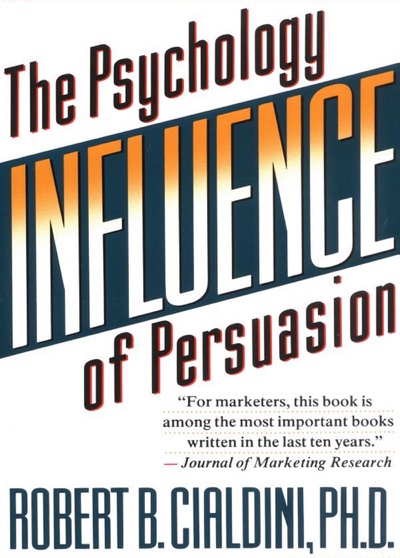
This is the better of the two persuasion books people quote at me. It is also the one they misuse most.
The six principles, in one paragraph
Reciprocation: we repay what we are given, including things we never asked for and did not want. Commitment and consistency: once we have taken a position — especially in public, especially in writing — we defend it, often well past the point where it still makes sense. Social proof: when we are unsure, we do what people like us are doing. Liking: we say yes to people we know, resemble, or have been complimented by. Authority: we defer to credentials, and to the symbols of credentials, which are considerably easier to fake. Scarcity: we want what is going away more than what is staying, and losing something moves us more than gaining the same thing.
Six categories, distilled from what Cialdini describes as thousands of individual tactics. The compression is the achievement.
What the book is actually doing
It is not a theory paper. Cialdini answered newspaper advertisements and got himself trained as an encyclopedia salesman, a vacuum-cleaner salesman, a portrait photographer, a fundraiser. The evidence comes from people whose livelihood depended on being right about this, which is a harder filter than peer review.
The organising idea is what he calls click, whirr: we run pre-loaded response patterns triggered by a single feature of a situation, because we cannot possibly think about all of it. The cleanest demonstration is Ellen Langer’s photocopier study. “May I use the machine because I’m in a rush” got 94 per cent compliance. “May I use the machine” got 60 per cent. And “May I use the machine because I have to make some copies” — which is not a reason, it is a restatement of the request — got 93 per cent.
The word because did the work. What followed it did not matter.
The three things I use
Not six. Three, and one of them is not even on the list.
Contrast. It sits in chapter one and gets left behind by everyone who quotes the six. Clothing stores train staff to sell the suit before the sweater, because a $95 sweater is outrageous on its own and trivial after a $495 suit. Estate agents keep a couple of overpriced wrecks on the books to show first. This is a free change to nearly every pricing page I am asked to look at, and it is the cheapest intervention in the book.
Arguing against your own interest. Cialdini watches a waiter called Vincent lean in and quietly tell a table that the dish they have just ordered is not good tonight, and recommend two cheaper ones. Vincent then sells them the wine and the dessert, and out-earns every other server in the restaurant. The small concession against himself bought credibility, which he spent on the large claim. Some version of this is in most of my engagements: the fastest route to being believed about what you are good at is being specific first about what you are not.
Small commitments, unpaid for. Jonathan Freedman told a room of seven-year-olds not to play with an expensive robot. Half got a severe threat. Half got a mild reason and nothing else. Both groups obeyed on the day. Six weeks later, with the adult long gone, 77 per cent of the threatened boys played with the robot and only 33 per cent of the others did. A commitment bought with a strong enough incentive produces compliance now and nothing at all afterwards. This is why discounting to close a deal is expensive twice.
Findings for product
Run these against one specific behaviour. Not against “the product”.
- Get a commitment early, keep it small, and do not pay for it. Freedman and Fraser asked householders to put a three-inch BE A SAFE DRIVER card in a window. Almost everyone did. Two weeks later, 76 per cent of them agreed to have an enormous, badly lettered DRIVE CAREFULLY billboard erected on their front lawn — against 17 per cent of the people asked cold. The mechanism is self-image, not the card. Which is exactly why an incentive kills it: if you paid me, I do not have to conclude anything about the sort of person I am.
- Make it visible. Deutsch and Gerard had students commit to a judgment three ways — not at all, privately on an erasable pad, and publicly with a signature. Willingness to change their minds later fell in that exact order. In a product this is the argument for a profile, a shared workspace, an invited colleague, a published page. Private settings hold nobody.
- Put the social proof where the hesitation is, and make it resemble the reader. Columbia researchers scattered wallets around Manhattan, each containing a letter from a previous finder who had tried to post it back. When that finder wrote like an ordinary American, 70 per cent of the wallets got posted on. When he wrote in broken English as a recent arrival, 33 per cent did. Same wallet, same money, same city. “Trusted by 10,000 companies” in your footer is doing almost none of this work. One named customer who looks like the visitor, placed at the step where they stall, is doing all of it.
- If you are going to give something, give it whole and give it first. The Hare Krishnas succeeded at airports by pressing a flower into somebody’s hand and refusing to take it back. Cialdini followed a member around O’Hare on her rounds of the bins, collecting the discarded flowers to recycle. People who binned the flower twenty feet later had already paid. A gated PDF is not a gift. It is a trade, and a trade creates no obligation whatsoever.
- Effort only creates attachment when it produces something the person keeps. Aronson and Mills put women through a genuinely embarrassing initiation to join a discussion group that had been rehearsed to be as dull as possible. They rated it as excellent. This is the same mechanism as onboarding, and the difference between friction that builds loyalty and friction that loses people is entirely whether they come out the other end holding something of their own.
Product test: if you switched off every notification and every discount tomorrow, which of your customers’ commitments would still be holding?
Findings for marketing
- Reorder the pricing page. Expensive first. That is the whole finding, it costs nothing, and it changes what the middle tier feels like to a reader who has never seen your prices before.
- Say what you are not good at, in public, before anyone asks. Vincent again. The concession has to be real and it has to cost you something visible, or it reads as a humblebrag and does the opposite.
- Only claim scarcity you can prove, and know which kind you have. Worchel gave people cookies from a jar. Two cookies in the jar rated better than ten. Ten that had just been reduced to two rated better still. And the very highest rating went to cookies that had become scarce because other people wanted them. Newly scarce beats always scarce; scarce through demand beats both. If none of that describes your situation then you do not have scarcity, you have a countdown timer, and people can tell.
- Ask people to predict what they will do. Steven Sherman phoned residents of Bloomington, Indiana, and asked them to say whether they would volunteer three hours for the American Cancer Society, if asked. Nobody enjoys saying no to that. When the real request arrived days later, volunteering was up 700 per cent. The marketing equivalents are close to free — the survey question, the “would you be interested in”, the waitlist. The commitment is the point. The data is a by-product.
- Run your own authority through the two questions your buyer is already using. Is this person genuinely an expert, and what do they gain by convincing me? Robert Young sold an enormous quantity of decaffeinated coffee on American television because he had played a doctor in a drama series, and everybody knew it, and it worked anyway. It still works. The reason to know this is not so you can borrow a title — it is that a credential which fails those two questions costs you more than it ever earned.
- Anchor high, then retreat — but stay inside plausible. Asking students to chaperone delinquents at the zoo got 17 per cent. Asking them first to commit two years as a counsellor and then retreating to the zoo trip got 50 per cent. G. Gordon Liddy walked into the same room three times — a million dollars, then half, then a quarter — and got the third, which turned into a burglary that ended a presidency. But research at Bar-Ilan found the whole thing reverses when the opening ask is seen as unreasonable. The retreat stops reading as a concession and starts reading as a tell. An anchor is a position. A fantasy is an insult, and gets treated as one.
Marketing test: name the last true thing you told a prospect that cost you money to say. If nothing comes to mind, you have claims rather than credibility.
What this means for SEO and GEO
Four of the six need somebody capable of feeling something. Reciprocity needs a person who can feel indebted. Liking needs one who can be charmed, flattered, or reminded that you grew up in the same town. Commitment needs a self-image worth protecting. Scarcity, in Cialdini’s account, runs on reactance — the objection to having a freedom taken away — and reactance requires a self for the freedom to be taken from.
A crawler has none of that. Neither does an assistant. You cannot make a language model feel it owes you, you cannot be more likeable to it, and it will not experience the loss of anything.
Two cross over intact: social proof and authority.
That is not a coincidence, and it is the part worth sitting with. Corroboration by independent others, weighted by who those others are, is not a persuasion tactic that happens to survive machine reading. It is a description of how ranking has worked since PageRank. Google’s E-E-A-T is Cialdini’s two machine-readable principles with a spreadsheet attached, and answer engines pick citations on the same basis: something enough sources agree on, said by an identifiable someone with a plausible reason to know it.
Which leaves a narrow surface, and it happens to be the honest half of the book. Be named by other people who are themselves worth naming. Be legible about who is speaking and why they would know — a byline, a real credential, a date, first-hand experience stated as first-hand, an identity that resolves to the same entity on every page and in every language you publish. There is no third move, and the absence of a third move is good news.
The warning runs the other way too. The one principle that does cross the gap, and should not, is manufactured scarcity. Countdown timers, “only three left” on a product with infinite inventory, urgency baked in at the template level: all of it reads as a low-trust signal to human quality raters, and therefore to anything trained on their judgments. In 1984 faked scarcity cost you one customer’s goodwill. Now it sits on every page of the site and costs you the citation.
None of this is in the book. Cialdini was writing about doorsteps, showrooms and telephones. But a taxonomy is only worth keeping if it still tells you something when you run it against a situation its author never saw, and this one does.
And the service translation, since this is the trade I sell: social proof and authority are positioning work — deciding who says what about you, in what order, with what evidence — and the contrast principle is the opening move of any pricing teardown. The commitment chapter is the mechanism underneath Hooked’s investment phase, and which claims deserve proof at all is a business-model question before it is a copy question.
Where it does not hold up
It is a filing system, not a theory. Six categories and no rule for what happens when two of them point in opposite directions, which in practice is most of the time. A discount engages self-interest and undermines commitment in the same movement. The book will explain either outcome beautifully, afterwards. It will not tell you which one you are about to get.
The defence chapters do not work, and the author is the evidence. Every chapter closes with a “How to Say No” section, and every remedy amounts to the same thing: notice it happening, then override it. That is being recommended for mechanisms the preceding two hundred pages have just spent considerable effort proving operate below conscious attention. The first line of the book is “I can admit it freely now. All my life I’ve been a patsy.” He then prints a story in which a woman with a clipboard walks him into an entertainment-club membership he does not want, using consistency, while he is a professor of social psychology researching compliance. He is the control group, and he failed. He publishes it anyway, which I respect. It does mean those sections read better as an admission than as a defence.
He removes price from the argument deliberately. Cialdini says early on that he will not treat material self-interest as one of the principles because it is “a motivational given” — obvious, and therefore not interesting. That is a defensible academic decision and a ruinous commercial one. Price is the variable most companies can actually move, and it is usually why I am in the room at all. A book about why people say yes that files what they pay under goes without saying has left out the lever.
Every mechanism assumes somebody is in the room. It was written in 1984 and the examples are doorsteps, dinner parties, showrooms and phone calls. The three principles that need presence — liking, reciprocity, and most of commitment — have thinned considerably now that most buying happens with nobody there. The three that travel through a screen — social proof, authority, scarcity — have been industrialised into review farms, bought credentials and template urgency. The book weights all six equally. The market stopped doing that a long time ago.
And the numbers belong to their period. A great deal of social psychology from these decades has been reconsidered since, on statistical grounds that were not widely adopted when the studies were run. My advice is to treat the individual figures here as illustrations of a mechanism you can go and test on your own funnel, rather than as findings to quote at people. The mechanisms have aged better than the percentages.
One point in its favour: Cialdini kept working. He has since added a seventh principle, unity — not merely resembling someone but belonging to the same group as them — which is not in this edition and which is, if anything, the one that has aged best.
Who should read it
Read it if you sell anything to anybody, and especially if you are the person writing the words. There is nothing else this concentrated on why one sentence gets a yes and a nearly identical sentence gets nothing at all. Chapters two and three cover the cost on their own.
Read it if you buy, as well. A good third of the value is defensive. You will start recognising the lowball, the run-down houses shown before the real one, the bank-examiner scheme, and the car salesman who disappears into his manager’s office to fight your corner — where, Cialdini reports from inside the dealership, he sits in silence with a soft drink for a decent interval before returning with the deal he already had.
Skip it if you were hoping for ethics. The moral question turns up in the epilogue and the answer is addressed to the victim: notice when a trigger has been faked, then retaliate — boycott, complain, write to the manufacturer. That is a consumer’s remedy. There is nothing here that constrains the practitioner, which is a strange gap in a book that hands the practitioner this much.
All six describe something people were already doing. You can use them to make a true offer easier to say yes to, or to make a false one survive contact with somebody’s judgment. The book teaches both, equally well, and then asks you nicely.
Common questions
What are Cialdini’s six principles of influence?
Reciprocation, commitment and consistency, social proof, liking, authority, and scarcity. We repay what we are given, even unasked-for gifts. We defend positions we have already taken, particularly public and written ones. When uncertain, we copy people who resemble us. We say yes more readily to people we like. We defer to authority, and to the symbols of it. And we want things more as they become less available. Cialdini deliberately leaves material self-interest off the list, calling it a motivational given.
Is Influence still worth reading?
Yes, with two adjustments. The mechanisms have held up better than the individual studies, many of which come from a period of social psychology that has since been reconsidered on statistical grounds, so treat the percentages as illustrations to test rather than facts to quote. And the book assumes a person is present for the persuasion, which is now often untrue — the principles that need presence have weakened and the ones that scale through a screen have been industrialised.
What is the rejection-then-retreat technique?
Make a large request you expect to be refused, then retreat to the smaller one you actually wanted. The retreat reads as a concession, and the reciprocity rule pressures the other person into a concession of their own — agreement. Asking students to chaperone juvenile delinquents at the zoo produced 17 per cent compliance; asking them first for two years of counselling and then retreating to the zoo trip produced 50 per cent. It reverses, though, if the opening request is seen as unreasonable, because the retreat then reads as a tactic rather than a genuine concession.
What does Influence say about SEO and AI search?
Nothing directly — it was written in 1984. Translated, four of the six principles need a person who can feel something: reciprocity requires the capacity to feel indebted, liking requires charm, commitment requires a self-image, and scarcity runs on reactance, which requires a self. Search engines and answer engines have none of these. Two principles cross over intact, social proof and authority, which between them describe how ranking and citation already work: corroboration by independent sources, weighted by who those sources are. Manufactured scarcity crosses over as well, but as a low-trust signal.
Where does Influence draw the line between influence and manipulation?
Largely, it does not. The distinction Cialdini offers is between triggers that are genuine and triggers that have been counterfeited — real popularity against staged testimonials, a real expert against an actor playing one, real scarcity against an invented deadline. But the argument appears in the epilogue and is addressed to the person being persuaded, who is urged to notice the fakery and retaliate. There is no equivalent constraint proposed for the practitioner, which is the book’s largest omission.